
Houston’s sports playbook ensures it shows up every year – not just every decade.
In September, global communications firm Burson released its data-driven ranking of the world’s 100 leading sports cities. Houston ranked No. 32 globally, No. 10 in the U.S., and No. 1 in Texas.
At first glance, the math placing Houston near the top seems obvious. Between July 2025 and June 2026, the period Burson measured, Houston hosted FIFA World Cup 2026, the World Baseball Classic, NCAA Men’s Basketball South Regional, Concacaf Gold Cup Final, and AAU Junior Olympic Games as major events.
The ranking analysis, which evaluates cities based on feedback from the international sports community and media visibility, revealed that mega-events are only part of the equation. What defines the cities atop the list is a robust, diverse sports calendar supported by a reliable sports ecosystem and infrastructure developed over the years. The leading cities remain connected to the global sports conversation every year, not just once every decade.
And it is what the Harris County–Houston Sports Authority (HCHSA) is delivering for the region year after year.
Since 2011, HCHSA has supported 130 sporting events. Of those, nine have been marquee national and international events, including Super Bowl LI, FIFA World Cup 2026, the NCAA Men’s Final Four, College Football Playoff National Championship, Concacaf Gold Cup Final, and AAU Junior Olympic Games.
Those nine events matter enormously, but equally important for a city – reputationally, socially, and economically – are the range of mid-sized and smaller hosted events that populate the sports calendar throughout the year.
What separates Houston from other cities is its ability to attract and secure the remaining 121 of those 130 events, which span a broad spectrum of highly sought-after anchor events that create a regular sports cadence year-round. They drive significant economic impact, create opportunities to activate the community, and keep Houston’s name in front of rights holders scouting their next location. (And that does not even account for the home schedules of Houston’s professional and collegiate teams that shape our city’s sports identity every day.)
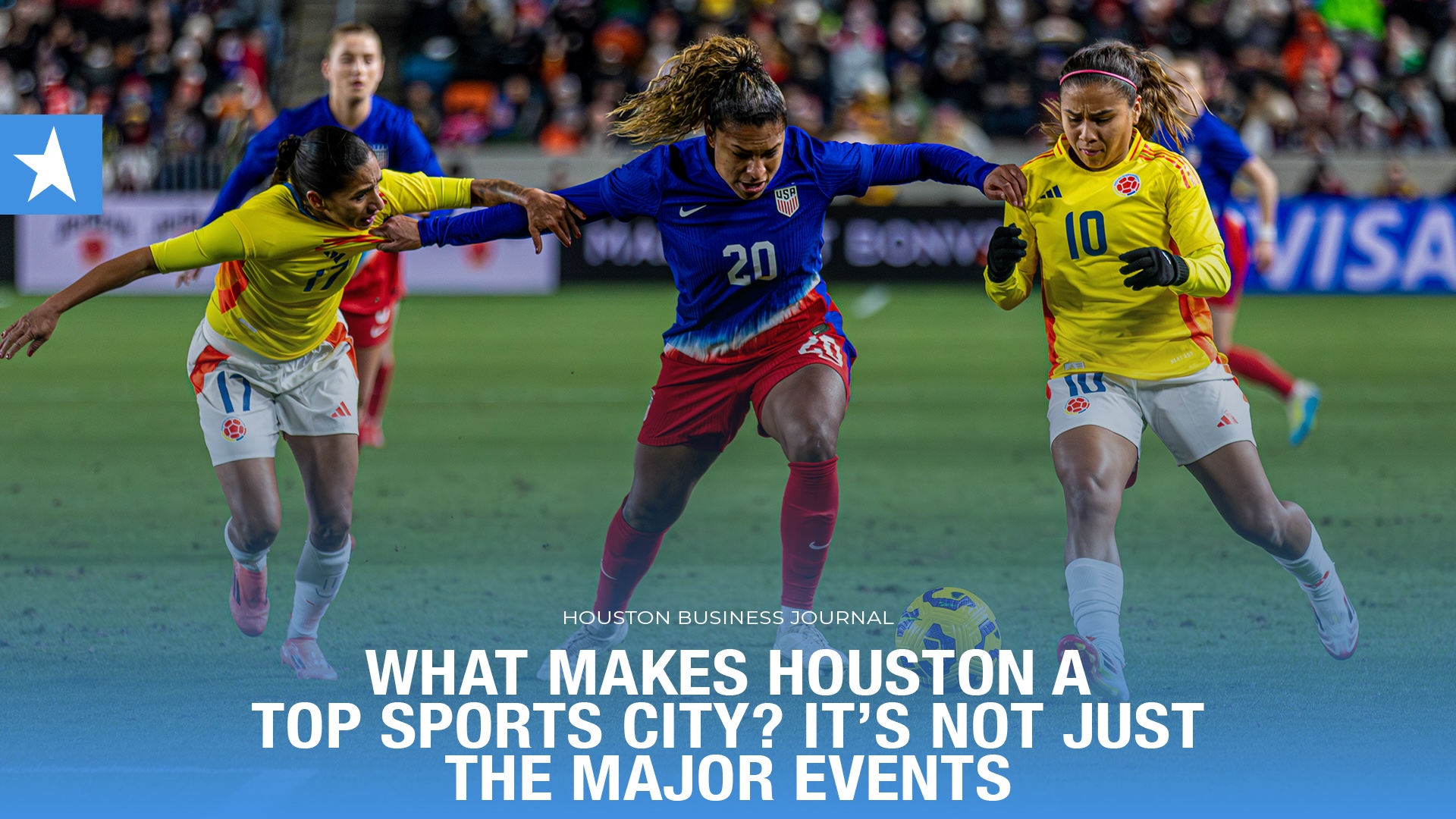
Before FIFA World Cup 2026, HCHSA’s efforts to attract sporting events had generated an estimated $2.6 billion in economic impact for the region. Approximately $1.2 billion – nearly half of that total – came from those 121 events. They include events such as the SheBelieves Cup, USA BMX Lone Star Nationals, and NCAA Division III football championship, along with upcoming events including the Concacaf W Championship, National Collegiate Rugby Men’s and Women’s XVs Championships, and 2030 World Masters Athletics Outdoor Championships.
Cumulatively, those events generate nearly the same economic impact for Houston–Harris County as the mega-events that capture the global headlines.
They also provide another benefit that is harder to quantify: experience. Every event that HCHSA secures doubles as a live rehearsal for the next one, building upon the operational muscle memory developed over decades of hosting. Executing multiple events annually means multiple opportunities to strengthen relationships with rights holders, develop volunteers, and tighten coordination with public stakeholders and venues – all the elements that must perform without fail for Houston to successfully host events on the scale of a FIFA World Cup.
Mega-events create extraordinary moments. They put Houston on television screens around the world, fill hotels and restaurants, and give the region opportunities few cities ever experience.
But they are not what sustains a sports city.
That happens in the years between the World Cups, Super Bowls, and Final Fours, when Houston is competing for collegiate tournaments, international competitions, youth events, and emerging sports that bring athletes and visitors to the region year after year.
Houston’s challenge is not simply winning the next mega-event. It is protecting and strengthening the year-round sports ecosystem and structures that make winning those events possible.
The world’s best sports cities don’t show up once every decade. They stay in the game every year.
